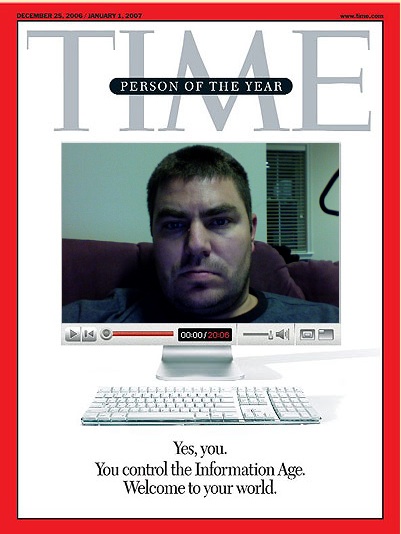


I’m not posting this because Saddam is dead. That is important, but being covered elsewhere. What I find interesting is how the presence of a cell phone camera disrupts all of the previously held conceptions of his hanging.
The grainy images are believed to have been filmed on a mobile phone. Unlike on the silent, official film showing a subdued Saddam Hussein, the execution is a charged, angry scene. In it people chant the name of radical Shia cleric Moqtada al-Sadr and tell Saddam Hussein to “go to hell”, while the former leader mocks their bravery. Link—>
Living in a science fiction world
Interesting post by Warren Ellis today….
…I share a conviction with Steven Shaviro, whose most recent book was CONNECTED, that we live in a science fictional world. Not the one everyone expected, of course — no jetpacks. But good science fiction, challenging science fiction, is never about the future we expect. Sf has never been about predicting the future. It’s been about laying out a roadmap of possibilities, one dark street at a time, and applying that direction to the present condition… Link—>
If you don’t get it, you don’t get it.
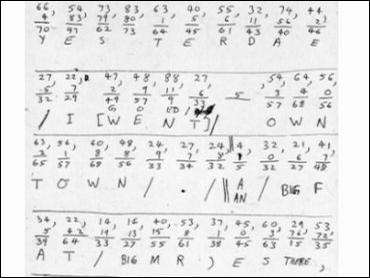
Unabomber’s Secret Code Cracked

A decade after the feds tracked him down, CBS 5 Investigates has uncovered exclusive new information about Unabomber Ted Kaczynski, including a secret code he developed, and the confessions revealed as the code is broken. Link—>
The Year of Computing (more) Dangerously
Washington Post has a good article about computer security trends for 2006. I’m not going to link to the Washington Post though. I want you to read the version with the Bruce Sterling commentary….
The result is that even if law enforcement or security experts manage to take down the infected PC responsible for relaying traffic to one of the scam sites, the effect of that takedown is only temporary, as the attackers can simply substitute another computer they have gained control over. Such scams make it far more difficult for security experts to find the true location of phishing servers. (((I was actually sitting in an audience when Donn Parker predicted that things like this would be possible someday. I was so impressed that I put it in the last chapter of my book HACKER CRACKDOWN. There’s a whole list of the guy’s dark imaginings in there. They all came true and then some.))) Link—>
I am not one to post book reviews on my blog, but given how much I enjoyed this book and seeing how the author self-published it, I am going to make an exception. G33k Mafia is an incredibly fun high-tech caper novel set in present time on the West coast. It tracks the adventures of a group of high tech criminals that survive off the grid (fake identities, no taxes, etc.) and use modern technology and ingenuity to plot small, but profitable capers. A recently fired game developer is sucked into their world and falls in love with the de-facto leader and the lifestyle. I think Dakan nails the off-the-grid subculture and certainly captures the excitement and anticipation of the groups exploits. I’m recommending it to all my techie friends.
Warren Ellis to write on SL for Newsweek…
“Second Life is not only the biggest digital art installation in the world, but potentially the most radical shift yet in the way communities are formed online, and possibly also the germ of the next great operating system,” Ellis said. “It’s not only a place where people get as strange as they can, but an incubator for the future.” Link —->
They don’t have bodies, but they do leave footprints…
I am not sure the math isn’t a little flawed, but an interesting, if not brilliant analysis:
If there are on average between 10,000 and 15,000 avatars “living” in Second Life at any point, that means the world has a population of about 12,500. Supporting those 12,500 avatars requires 4,000 servers as well as the 12,500 PCs the avatars’ physical alter egos are using. Conservatively, a PC consumes 120 watts and a server consumes 200 watts. Throw in another 50 watts per server for data-center air conditioning. So, on a daily basis, overall Second Life power consumption equals… 60,000 kilowatt-hours….
Which, annualized, gives us [an average avatar consumption of] 1,752 kWh. So an avatar consumes 1,752 kWh per year….. [T]he average citizen of Brazil consumes 1,884 kWh, which, given the fact that my avatar estimate was rough and conservative, means that your average Second Life avatar consumes about as much electricity as your average Brazilian.
Which means, in turn, that avatars aren’t quite as intangible as they seem. They don’t have bodies, but they do leave footprints. Link—>