July 2007
Monthly Archive
Technology20 Jul 2007 04:28 pm
A Must Read Essay by Kevin Kelly
Kevin Kelly’s book Out of Control was very influential in my early research. His new essay takes things to an entirely new and somewhat uncomfortable intellectual level. Selected excerpts below…
THE TECHNIUM AND THE 7TH KINGDOM OF LIFE
A Talk with Kevin Kelly
What is the meaning of technology in our lives? What place does technology have in the universe? What place does it have in the human condition? And what place should it play in my own personal life? Technology as a whole system, or what I call the technium, seems to be a dominant force in the culture. Indeed at times it seems to be the only force — the only lasting force — in culture. If that’s so, then what can we expect from this force, what governs it? Sadly we don’t even have a good theory about technology.
The prospect of genetic forking is probably the most divisive issue I could imagine for our species and would engender conflicts at a scale that will make some of today’s inherently irresolvable issues — abortion, cloning, etc. — pale by comparison. There will be people who would not only declare that they want to remain untouched (the “Naturals”) but would insist that no one has the right to remake themselves or their unnamed descendents.
Others will clearly side with humans remodeling themselves and the species in any direction possible. It’s not so far away, either. The unanswerable questions are already beginning. Is a sprinter with two prosthetic carbon-fiber springs instead of legs, disabled or enhanced? If he wants to compete in the Olympics, are his springs a crutch, or a jet pack? What is a human anyway?
Hollywood and science fiction authors are the new theologians. They’ve been asking these essential existential questions way ahead of the rest of society. The rising popularity of maverick authors like Philip K Dick will move him (and others of his ilk) into the core mainstream, as the themes he explored become the central questions of the coming century.
What is the difference between fake and reality? Who are we? Are we many or one? Where do we begin and our minds end? These are old themes, but with new answers and alternative story lines, and it’s not just the artists that are asking these questions.
We are reaching down deep into the culture so that everybody has to ask these very big questions. It’s no longer the job of philosophers, nor avante guard artists — but ordinary citizens. With each new headline in USA Today, everyone is being asked, What is a human? A vernacular theology, in a certain sense, is one of unanticipated aspects of this technological culture.
Technology20 Jul 2007 04:27 pm
On the Front Line in the War on Terror
Interesting article by Judith Miller contrasting the different counterterrorism approaches in Los Angeles and New York City. Both cities have been on the cutting edge in their own unique way…
Despite their differences, both the NYPD and the LAPD agree that a key way to crush incipient terrorist cells and thwart terrorism is to use local laws and follow locally generated leads, which, after all, is what good police departments do best. Link—>
Technology20 Jul 2007 04:27 pm
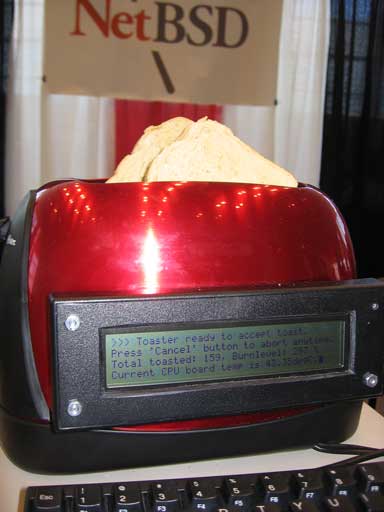
Another Toaster Picture…

I will never tire of this. This variant is actually a toaster running Linux. Personally, I welcome our toaster overlords. Link—>
Technology20 Jul 2007 04:27 pm
Dilemma of the Patriotic Hackers
Haft of the Spear alerted me to this manifesto, which couldn’t help but remind me of its 1994 counterpart.
Technology20 Jul 2007 07:59 am
Death of the OODA Loop?

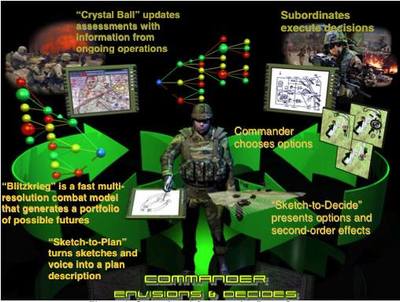
Interesting article at Wired discussing some new initiatives at DARPA to support decision-making on the battlefield. Most notably, they seek to compress the OODA loop into one prescient technology.
Specifically, the “venerable Observe Orient Decide Act (OODA) loop is no longer viable for an information-age military.” To fight a fast-moving foe, these four tasks have to now happen all at once. That’s the goal of Deep Green. Link—>
The SKYNET references remind me of a slide I put together in 2005.

Of course, at what point does Deep Green present us with this dilemna?

Computer Mod That Made Me Smile
Only really funny if you’ve read this paper.

Technology14 Jul 2007 03:02 pm
Robert Scoble is Media
Fascinating blog post here, which was discovered via this link.
Compelling look at the value of all these new social network sites we keep joining, but haven’t quite figured out what they are there for.
Security11 Jul 2007 09:47 pm
Homeland Security - A Guide to Deciphering Guts

It seems the folks at Wired Magazine have developed the homeland security gut guide based on the reporting that Secretary Chertoff has a “gut feeling” about a period of increased risk to the homeland.
All joking aside, from an analyst’s perspective, we shouldn’t diminish the role that the “gut” or “intuition” plays in the predictive analysis process. Intuitively, our gut feelings are drawn from experiential patterns that our brains use to try and predict the next sequence of events. If I type “Mary had a little ______”, you are inclined to predict “lamb” as the next word in the sequence even though “problem” or “nose” are also valid options. Secretary Chertoff is exposed to one of the most massive data sets relating to domestic homeland security threats and threats and attacks that have manifested themselves overseas. If he has a “gut feeling” that something is coming, it means that there is some sensory input that is leading him to predict an attack in the near-term sequence of forthcoming events. While I enjoy the lambasting as much as the next person, I am not as quick to dismiss it as others have been.
Of course, there is always a catch. In this instance, I would attract your attention to three catches. First, I don’t think the experiential data sets are significant enough to distinguish meaningful patterns at the level Chertoff is analyzing them. Second, we are dealing with inherently unpredictable adversaries displaying at least an notional capability to adapt and surprise. Lastly, some experiential patterns are known well enough by the terrorist adversary to allow them to engage in deception (for example the heavily discussed concept of “increased chatter”). As an essay on the CIA’s own site points out:
To the extent that perception is influenced by expectations, analysts may have missed or discounted the contrary instances. People also have a better memory for recent events, events in which they were personally involved, events that had important consequences, and so forth. These factors have a significant influence on perceptions of correlation when analysts make a gut judgment without consciously trying to think of all four cells of the table. Many erroneous theories are perpetuated because they seem plausible and because people record their experience in a way that supports rather than refutes them. Link —>
Think of the “terrorist problem” in the context of that last paragraph. Many have also been skeptical that Chertoff was simply engaging in the “politics of fear” and that using a fuzzy metric such as a “gut feeling” is a low risk way to increase the perception of threat. Given the White House backtracking on the statement, I don’t think the comment was anything but a genuine informal assessment. I know I’ve shared “gut feelings” with my colleagues on several occasions and a few times in the international media. Speaking to these “gut feelings” only provides another metric for the budding analysts to put in their own experiential data sets that they’ll draw on for future gut feelings of their own.
Technology11 Jul 2007 09:04 pm
Battle of the Shadow Phones
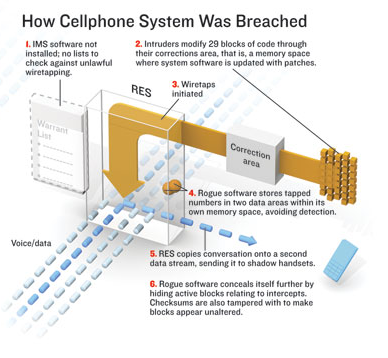
IEEE is running a fascinating article on a discovered intrusion into major Greek cellular networks for the purpose of engaging in unauthorized eavesdropping of prominent officials including the Prime Minister and his wife. In a world where credit card thieves and low-level hackers get all the headlines, security professionals should make special note of the sophistication of this attack.
On 9 March 2005, a 38-year-old Greek electrical engineer named Costas Tsalikidis was found hanged in his Athens loft apartment, an apparent suicide. It would prove to be merely the first public news of a scandal that would roil Greece for months.
The next day, the prime minister of Greece was told that his cellphone was being bugged, as were those of the mayor of Athens and at least 100 other high-ranking dignitaries, including an employee of the U.S. embassy. [See sidebar "CEOs, MPs, & a PM."]
The victims were customers of Athens-based Vodafone-Panafon, generally known as Vodafone Greece, the country’s largest cellular service provider; Tsalikidis was in charge of network planning at the company. A connection seemed obvious. Given the list of people and their positions at the time of the tapping, we can only imagine the sensitive political and diplomatic discussions, high-stakes business deals, or even marital indiscretions that may have been routinely overheard and, quite possibly, recorded.
Even before Tsalikidis’s death, investigators had found rogue software installed on the Vodafone Greece phone network by parties unknown. Some extraordinarily knowledgeable people either penetrated the network from outside or subverted it from within, aided by an agent or mole. In either case, the software at the heart of the phone system, investigators later discovered, was reprogrammed with a finesse and sophistication rarely seen before or since. Link —>
Technology10 Jul 2007 10:05 pm
Ubuntu Impressions

Last night was my first foray into the Ubuntu distribution and I must admit to being surprisingly impressed. I’ve installed various versions of Linux with varying degrees of success since their was a “Linux”. My most recent distro of choice was Open Suse, but while it was fun to explore and learn on, it was definitely not polished enough to recommend for the generic consumer desktop. Ubuntu represents the first distro that I could seriously recommend to the average user as a Linux solution that just works. Here’s why….
1) Installation was a breeze. If you can install Windows or Mac OS X you can install Ubuntu. Linux distros have come a long way in recent years with regards to installability, but Ubuntu is the cleanest experience yet.
2) Common problems in other distros were absent in Ubuntu when installing on the same hardware. When I installed Open Suse on the same laptop I had a few plaguing issues I had to seek help on; a) the display resolution did not set correctly resulting in black bars on each side of the LCD; b) the wireless network card would not work. Both issues were eventually sorted out on Suse, but not without some work and outside help. On Ubuntu, neither was an issue and I got a fully functional machine right out the gate.
3) Common applications just worked and plugins were automated and fully functional in minutes. All the common consumer apps are there and easily accessible. Browsing, email, opening office docs, playing music and movies. When I first encountered a flash site I was prompted to install Flash and the experience was similar to what one would get on Windows or OS X. When I tried to play my Internet radio stream, I was prompted to install the codec and then it just worked. All hardware seems to be recognized and audio/video playback works like a charm.
4) The graphical user interface is both pleasing and intuitive.
The installation on Ubuntu on this Sony Vaio laptop has breathed new life into this machine and given me a very powerful and extremely portable Linux box to travel with. If I had my druthers, I’d load Mac OS X on it, but installing Ubuntu is the next best thing.
Next Page »